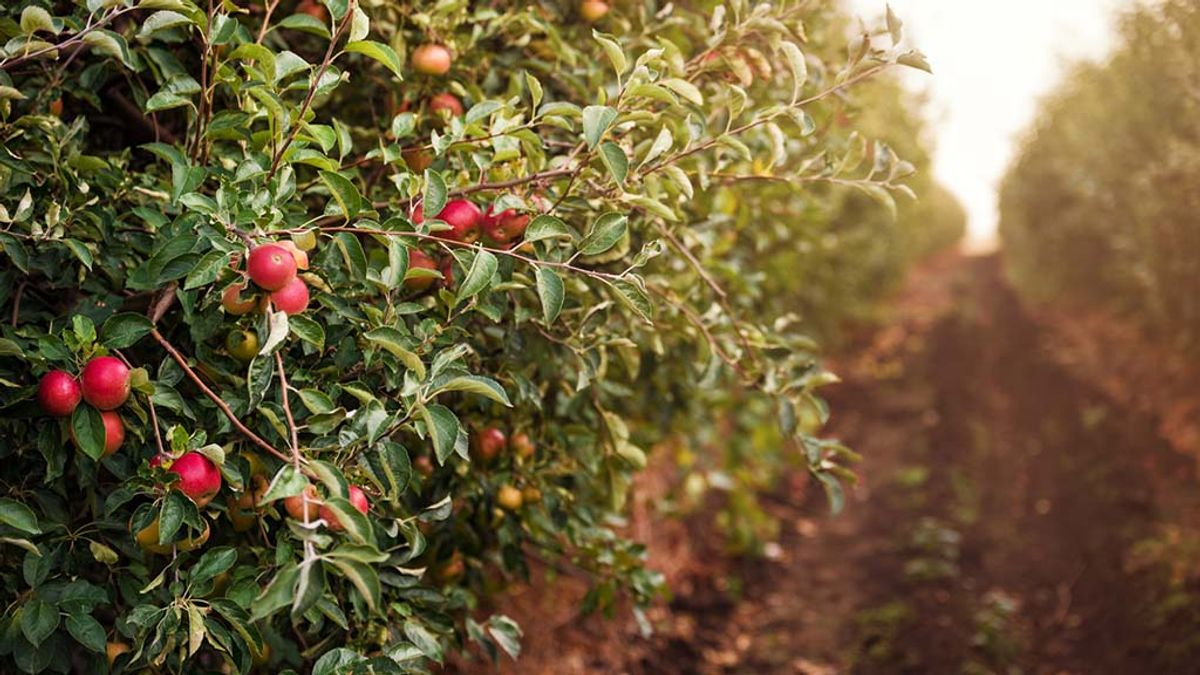
Kashmir’s traditional apple-growing landscape is undergoing a gradual transformation, with an increasing number of growers shifting to high-density plantations in pursuit of higher productivity, better fruit quality and improved market returns.The shift, initially adopted by a relatively small number of progressive growers, has gained momentum in recent years as the government promotes modern orchard systems and growers increasingly look for ways to improve returns from limited landholdings.
The Jammu and Kashmir Government’s latest Budget 2026-27 states that about 1,119 hectares have been covered under the High-Density Plantation Scheme since 2017-18 up to December 2025, with financial assistance of Rs 139 crore. The government has further proposed bringing 1,455 hectares under high- and medium-density plantations during 2026-27.
The broader transition is substantially larger when both high- and medium-density plantations are taken into account. According to the NITI Aayog’s Roadmap for Horticulture Development in the UT of Jammu and Kashmir, 4,023 hectares were brought under high/medium-density plantations in 2023-24, following 4,776.88 hectares in 2021-22 and 2,540.04 hectares in 2022-23.The government has also approved a Revised Modified High Density Plantation Scheme covering 5,500 hectares of multiple fruit crops, including apple, walnut, almond and cherry, over five years from 2022-23 to 2026-27, with an overall 50 per cent subsidy provision.
Recent parliamentary data also indicates that around 300 hectares of traditional apple and walnut orchards in J&K have been converted into high-density plantations under government schemes over the past five years, while another 909.13 hectares have been brought under new high-density plantations during the same period.
In Baramulla, one of Kashmir’s major apple-growing districts, the adoption of the system has also been significant. Data presented in Parliament showed that 599 beneficiaries in the Baramulla Lok Sabha constituency had been assisted under the High-Density Plantation Programme, covering 244.646 hectares between 2016-17 and 2025-26. The highest annual coverage was recorded in 2025-26, when 58.036 hectares were brought under high-density plantations and 277 beneficiaries were assisted.Chief Horticulture Officer, Baramulla, Javed Ahmad said the shift towards high-density plantations was gaining pace because of the economic advantages associated with the system. “High-density orchards are developed through a specific technique and require the same level of care and management as traditional orchards,” Ahmad said.
He said growers were increasingly showing interest in newer apple varieties, particularly Gala, which has emerged as one of the preferred varieties in high-density plantations.
“We are importing Gala varieties which have tremendous market value. Gala has good colour and several other desirable characteristics, and our climate suits it well,” he said.
Ahmad said the department was also looking at introducing more varieties suited to Kashmir’s climatic conditionsThe density of plants is much higher in high-density orchards. We can plant more trees in the same area,” Ahmad said.
He said the selection of rootstock was particularly important, with M9 being widely used because of its dwarfing characteristics. “The rootstock should not be vigorous. That is why the M9 is widely used,” he said.
Apart from allowing more plants per hectare, high-density orchards are gaining popularity because of the quality of fruit they produce.
“In a traditional orchard, a tree may produce 20 to 30 boxes, but only around 30 per cent may qualify as A-grade fruit. In high-density plantations, the proportion of A-grade fruit can be as high as 90 per cent,” Ahmad said.
The difference has significant implications for growers, as premium-grade apples generally fetch better prices in domestic and outside markets.
The shift is also part of a wider government strategy to modernise J&K’s horticulture sector. The Economic Survey 2025-26 identifies high-density fruit plantation, introduction of high-value varieties and superior rootstocks, rejuvenation of old and senile orchards, mechanisation and expansion of cold-chain infrastructure among the key priorities for the sector.
Jammu and Kashmir’s horticulture sector remains a major contributor to the regional economy. The NITI Aayog roadmap notes that the area under major horticulture crops increased from 3.35 lakh hectares in 2020-21 to 3.45 lakh hectares in 2023-24, while production rose from 22.30 lakh tonnes to 26.43 lakh tonnes during the same period
