
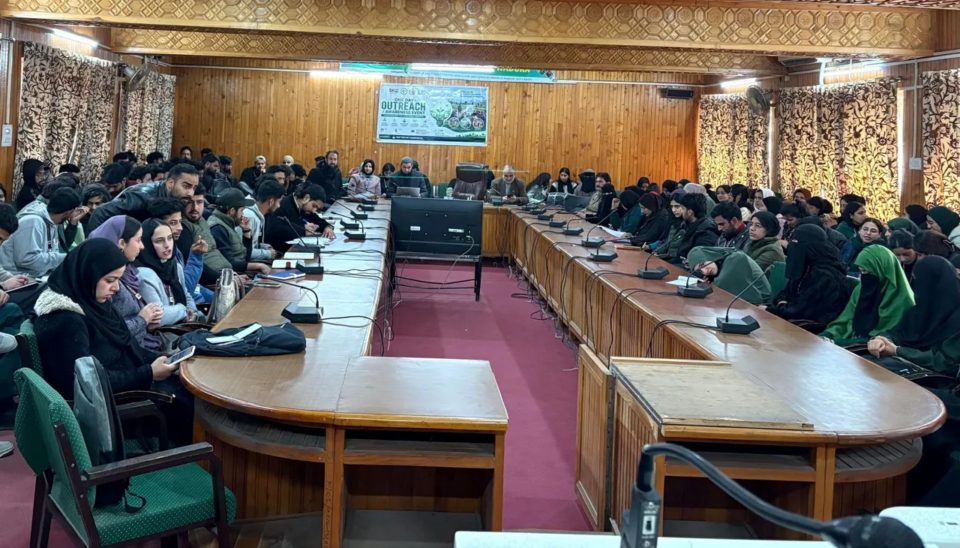
Sher-e-Kashmir University of Agricultural Sciences and Technology of Kashmir (SKUAST-Kashmir) organised an outreach programme at its Faculty of Agriculture, Wadura, to familiarise students with agribusiness start-up opportunities, incubation support and avenues for converting innovative ideas into viable enterprises.
Organised through the JKCIP Start-up and Incubation Cell under the theme “Innovating Today for a Sustainable Tomorrow”, the programme focused on developing an entrepreneurial mindset among agricultural graduates and encouraging them to explore opportunities beyond conventional career pathways.
Dr. Najeeb Sofi, Dean, Faculty of Agriculture, encouraged students to harness agricultural knowledge, research and technology to develop innovative solutions to emerging sectoral challenges.
Dr. Parvaiz A. Sofi, Associate Dean, highlighted the importance of identifying practical agricultural problems and translating research-based ideas into entrepreneurial ventures.
Expert sessions by Dr. Azra Mufti, Business Development Manager, Agricultural and Processed Food Products Export Development Authority (APEDA), and Dr. Ab Rouf Khan, Incubation Manager, SKUAST-Kashmir Institute of Innovation, Incubation and Entrepreneurship (SKIIE), focused on opportunities in agricultural value addition, food processing, market-oriented product development and youth-led agribusiness ventures.
Dr. Mohammad Mubashir, Manager Incubation, JKCIP, outlined the support available under the JKCIP Start-up and Incubation Component, including institutional assistance and opportunities for aspiring entrepreneurs.
The programme also featured interactive mind-mapping exercises in which students identified agricultural challenges, generated business ideas and developed preliminary enterprise concepts. An interactive session provided them an opportunity to seek guidance from experts on start-up development and incubation support.
The initiative is part of SKUAST-Kashmir’s efforts to strengthen its entrepreneurship ecosystem and encourage young agricultural graduates to emerge as innovators and job creators in the agribusiness sector.
