
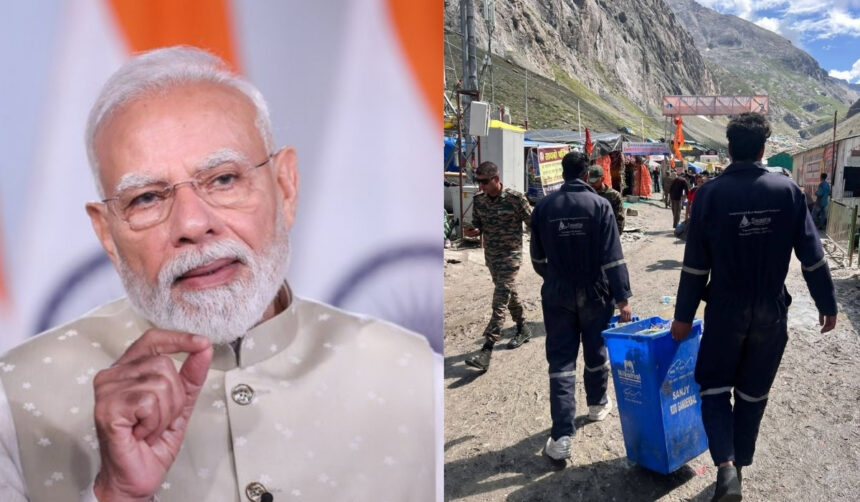
The comprehensive sanitation and scientific waste management system implemented during the Shri Amarnath Ji Yatra 2026 has received national recognition, with Prime Minister Narendra Modi highlighting the Yatra’s sanitation arrangements and waste management model in the latest episode of “Mann Ki Baat.” The mention has been hailed as a proud moment for the Rural Development Department (RDD) J&K and its Directorate of Rural Sanitation, whose exemplary work was carried out under the able leadership of Lieutenant Governor Manoj Sinha, Chairman of the Shri Amarnath Ji Shrine Board (SASB).
“Swachhta as Seva and Shraddha”
The Prime Minister’s remarks came shortly after the conclusion of the 57-day Yatra on August 28, 2026, and appreciatively recognised the coordinated efforts undertaken to manage sanitation and waste across the challenging Himalayan terrain. In the 137th episode of Mann Ki Baat, Modi highlighted the efforts of thousands of sanitation workers who worked day and night to serve pilgrims along the arduous route, saying that cleanliness has a very great quality — when the resolve to keep a place clean becomes the people’s own resolve, the change does not remain limited only to cleanliness, but enhances the beauty and identity of a place.
Officials described the recognition as a reflection of “Swachhta as Seva and Shraddha” — cleanliness as both service and devotion — a principle that guided the sanitation efforts undertaken under the leadership of Lieutenant Governor Manoj Sinha, Chairman of the Shri Amarnath Ji Shrine Board (SASB).
A Comprehensive Sanitation Framework
The Directorate of Rural Sanitation, under the Department of Rural Development and Panchayati Raj, J&K, implemented a comprehensive sanitation and waste management framework across the Baltal and Pahalgam axes, base camps, and key Yatra locations. The system was designed to cater to the requirements of lakhs of pilgrims while ensuring that cleanliness and environmental protection remained central to the management of the pilgrimage.
More than 8,000 sanitation facilities, including toilets, bathing facilities, and prefabricated sanitation structures, were deployed across the Yatra ecosystem, supported by dedicated sanitation personnel stationed along the routes, camps, and high-footfall areas. Their responsibilities extended beyond routine cleaning to include continuous upkeep of sanitation facilities, prevention of litter accumulation, and maintenance of hygienic conditions throughout the pilgrimage.
Zero Waste to Landfill Approach
A robust scientific solid waste management system was simultaneously operationalised to manage the substantial quantum of waste generated during the Yatra, covering the complete chain from source-level segregation and collection to transportation, processing, and responsible disposal. Under the Zero Waste to Landfill approach, a total of 414.46 metric tonnes of waste was collected and processed during the Yatra.
Officials noted that the intervention assumed particular significance given the fragile ecological character of the Himalayan terrain through which the Yatra passes, with the integration of sanitation infrastructure and scientific waste management helping minimise the environmental footprint of the large-scale pilgrimage while maintaining essential public health and hygiene standards.
Recognition for “Team Jammu Kashmir”
The national recognition comes alongside separate felicitation ceremonies in which Lieutenant Governor Manoj Sinha honoured officers and personnel of the Shrine Board, civil administration, Army, CAPFs, J&K Police, BRO, medical teams, sanitation workers, and other stakeholders for ensuring a smooth, secure, and dignified pilgrimage. Addressing the gathering, Sinha said the successful conduct of the Yatra was not the achievement of any single institution or department, but the collective effort of “Team Jammu Kashmir,” which transformed hardships into duty, challenges into opportunities, and service into a form of spiritual practice.
