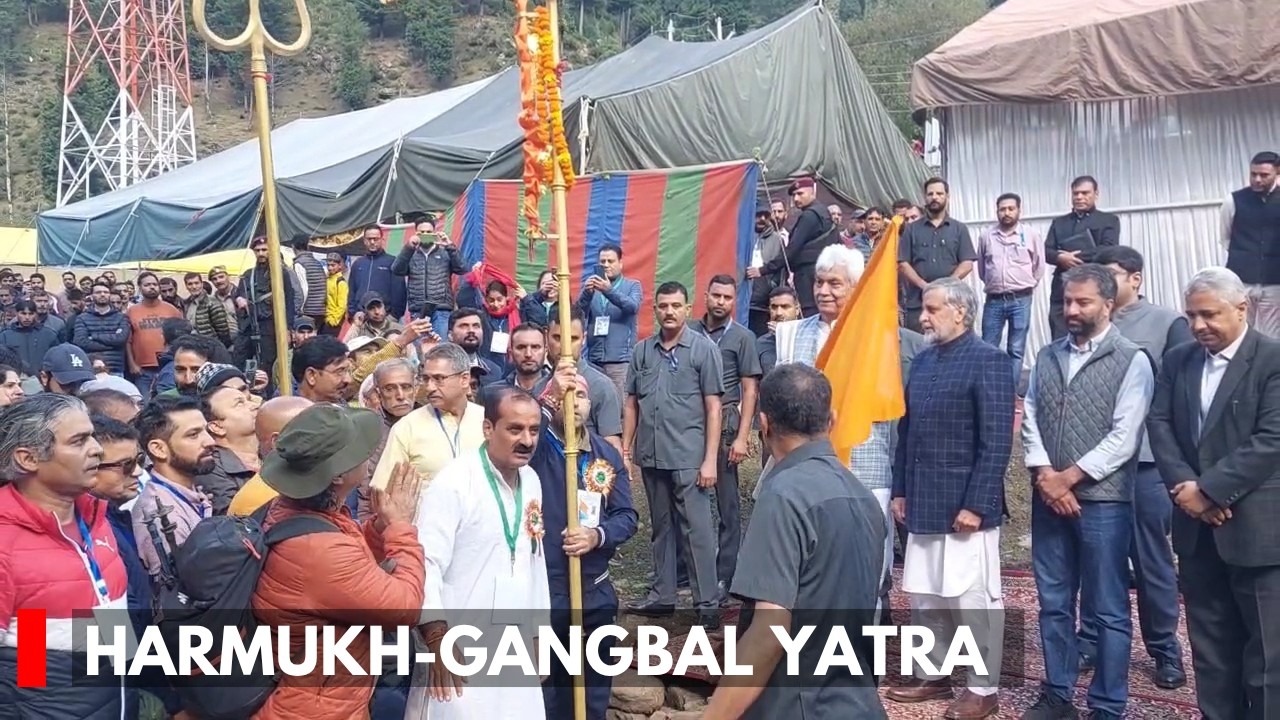
Jammu and Kashmir Lieutenant Governor Manoj Sinha arrived at Naranag to flag off the annual Gangabal Yatra, marking the beginning of one of the region’s most cherished pilgrimages, even as he reaffirmed that “Jammu & Kashmir moves forward on the path of peace and progress.”
A Message of Stability and Growth
Speaking on the occasion, the Lieutenant Governor’s remarks reflected the administration’s continued emphasis on framing the successful conduct of religious and cultural traditions as tangible evidence of the peace and stability now taking root across the Union Territory. His statement underscored a broader narrative that has come to define recent years — one in which age-old pilgrimages, once disrupted by decades of conflict and instability, are being revived and celebrated with renewed confidence and institutional support.
Flagging Off a Sacred Tradition
The Lieutenant Governor’s presence at Naranag to flag off the Gangabal Yatra carried particular significance, given the pilgrimage’s deep spiritual importance for the Kashmiri Pandit community. The sacred Harmukh-Gangabal Lake, situated at an altitude of around 14,500 feet in the Harmukh mountain range of Ganderbal district, is considered an abode of Lord Shiva and holds a status among devotees comparable to that of Haridwar.
After performing special prayers at the Naranag temple, pilgrims set off on a roughly 15-km trek towards Gangabal Lake via Butchari and Trunkhal, accompanied by security personnel to ensure their safety along the challenging high-altitude route. Upon reaching the lake, a ceremonial puja is performed on its banks, following which devotees begin their return journey the next day, completing the traditional three-day pilgrimage.
A Tradition Revived
The Gangabal Yatra, organised under the banner of the Harmukh Ganga (Gangabal) Trust and the All Parties Migrants’ Coordination Committee, was revived in 2009 after a long hiatus, as part of sustained efforts by the Kashmiri Pandit community to preserve their cultural and religious heritage and restore access to their significant holy sites. Since its revival, the pilgrimage has steadily grown in participation, supported each year by comprehensive administrative arrangements for boarding, lodging, medical care, and security along the route.
Peace as a Precondition for Progress
The Lieutenant Governor’s remarks linking peace with progress reflect a broader governance philosophy that has repeatedly framed the successful, uninterrupted conduct of religious pilgrimages — including the Shri Amarnath Ji Yatra and now the Gangabal Yatra — as concrete markers of improving security conditions in Jammu and Kashmir. Officials have often pointed to the growing scale and smooth conduct of such Yatras as evidence that the region’s traditional festivals and pilgrimages, once curtailed by instability, are now being restored to their full religious and cultural significance.
Administrative Support for the Pilgrimage
As in previous years, the district administration of Ganderbal has put in place elaborate arrangements to facilitate the Yatra, including deployment of security personnel, medical camps, and logistical support for the devotees undertaking the demanding trek. Such arrangements are aimed at ensuring that pilgrims, many of whom are elderly or travelling considerable distances to participate, are able to complete the Yatra safely and comfortably.
A Reflection of Broader Governance Priorities
The Lieutenant Governor’s participation in flagging off the Gangabal Yatra, alongside his remarks on peace and progress, reflects the administration’s continued effort to position the successful conduct of religious and cultural events as central to its broader governance narrative for Jammu and Kashmir. As the pilgrimage proceeds over the coming days, officials expect the Yatra to conclude smoothly, further reinforcing the message that the region’s traditions, once threatened by years of unrest, are now flourishing once again under improved security conditions.
