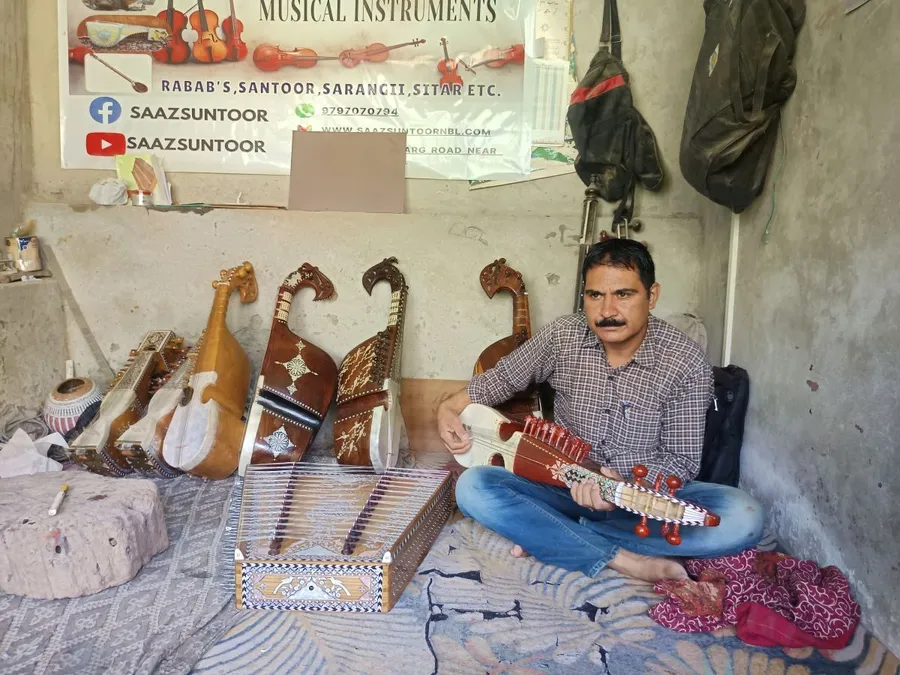
In a modest workshop in Narbal village on the outskirts of Srinagar, the steady rhythm of chisel against wood tells a story older than most living memories. For 32 years, artisan Mushtaq Ahmad Dar has devoted his life to a single mission: keeping Kashmir’s traditional musical instruments from fading into silence.
Dar picked up his first tools at the age of eight, learning at the side of his father — a veteran craftsman who spent more than five decades perfecting the art. What began as a child sitting beside his father in a small workshop has grown into a life’s work spanning three decades, one instrument at a time, each piece a quiet act of inheritance.
An Art That Takes Months, Not Days
Dar’s craftsmanship spans a remarkable range of traditional instruments, including the Rabaab, Santoor, Saz-e-Kashmir, Kashmiri Sitar, Sikh Rabab and Kashmiri Surnai. Each piece demands weeks of painstaking labour, and Dar insists there are no shortcuts when it comes to preserving quality and authentic sound.
He has explained that preparing a single instrument takes nearly two months, and that rushing the process to finish in twenty days would compromise its craftsmanship and tone. That patience, he believes, is what separates a genuine handcrafted instrument from the mass-produced imitations increasingly flooding the market today. Every curve of wood, every taut string, is shaped by hand and by an ear trained over decades to recognise the right resonance.A Legacy Passed Down Through Generations
For Dar, the craft is inseparable from family memory. His father’s dream was always to pass this fading art to the next generation, and Dar has carried that responsibility forward with quiet determination. Working largely from home, he continues to devote long hours — often stretching into the night — to fulfil orders and refine his technique.
“My father taught me this art, and I want to preserve it for our future generations,” Dar has said, describing a discipline that has remained the singular focus of his adult life. Beyond his own workshop, other artisans in the region have also begun training apprentices, teaching the next generation of craftsmen so the skills involved don’t disappear with a single family line, even as fewer young people show interest in taking up such demanding, low-paying work.Why These Instruments Matter
Kashmir’s traditional instruments are deeply tied to Sufiana Mausiqi — a centuries-old musical tradition blending Persian, Central Asian and Kashmiri influences that once flourished under royal and Sufi patronage. Instruments like the Saz-e-Kashmir and Santoor sit at the heart of this mystical musical form, and artisans across the Valley have long warned that the tradition is struggling to survive as fewer master-musicians and craftsmen remain active today.
Dar, along with other artisans working in villages across Budgam, Kulgam and Srinagar, forms part of a small but resilient network keeping these skills alive — often against economic odds, as demand for handmade instruments competes with cheaper factory alternatives and younger generations gravitate toward more stable livelihoods elsewhere.
Keeping the Music Playing
For Mushtaq Ahmad Dar, every finished instrument is more than a commercial product — it is a continuation of memory, culture and identity. As Kashmir’s musical instrument-making tradition faces an uncertain future, artisans like Dar remain its quiet custodians, ensuring that the sounds of the Rabaab and Santoor continue to echo through the Valley for generations to come.
