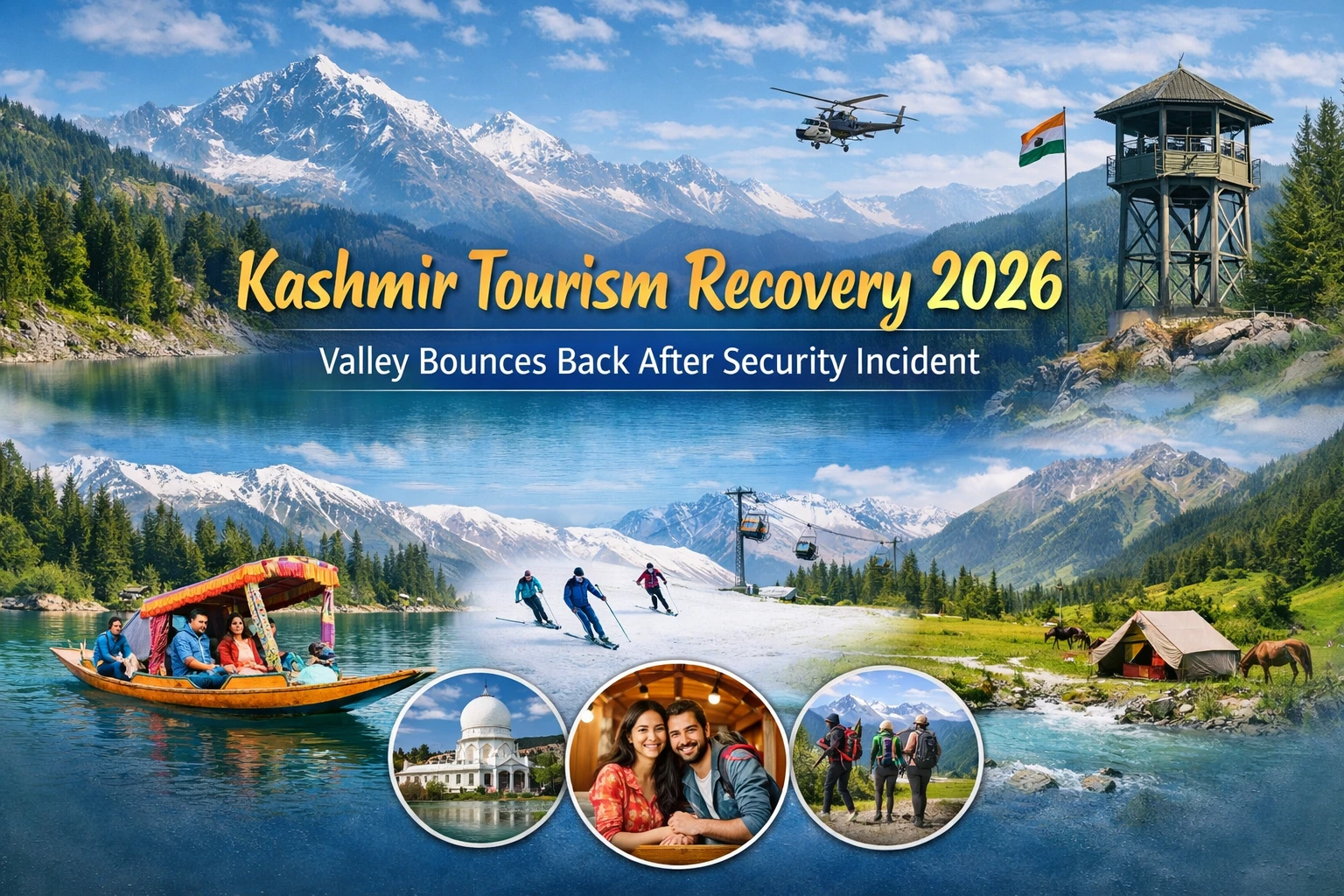
Tourism is, at its core, a confidence business. Nobody books a houseboat on Dal Lake or a trek through Sonamarg based purely on scenery — they book it based on a belief that the trip will be safe, smooth, and worth the risk of travel itself. That’s what makes Kashmir’s summer 2026 numbers worth examining closely: 8,07,008 tourists visited the Valley between May and July, up 357 percent from the 1,76,751 recorded in the same period last year. But behind that headline lies a more instructive story about how quickly, and how unevenly, confidence can be rebuilt after it’s been shattered.
The Anatomy of a Collapse
To understand this recovery, it helps to remember what came before it. In April 2025, an attack in Pahalgam’s Baisaran meadows killed 25 tourists and a local guide, striking at the heart of Kashmir’s most iconic tourist circuit. The economic aftershock was immediate and severe — nearly 90 percent of travel bookings were cancelled within days, gutting an industry that had, until that point, been riding an unprecedented high, with 2024 arrivals touching close to 35 lakh visitors. When an economy is this dependent on a single variable — perceived safety — a shock of that magnitude doesn’t just dent demand; it can temporarily erase it.Reading the Recovery Curve
What’s notable about this year’s rebound is its shape. Confidence didn’t return all at once; it built incrementally. May’s arrivals reached 2,19,449, more than tenfold the 18,853 recorded a year earlier. June pushed higher still, to 3,21,196, and July settled at 2,66,363. This gradual acceleration, rather than a single dramatic spike, is typically how recoveries from confidence shocks actually unfold — first a trickle of early, risk-tolerant travelers, then a wider wave as word spreads that the destination is, in fact, functioning normally again.
A Domestic-Led Recovery
Notably, this recovery has been financed almost entirely by domestic demand. Indian travelers drove the vast majority of the increase, climbing from 1,74,128 to 8,02,871 across the three months, while international arrivals crept up only slightly, from 2,623 to 4,137. This divergence is economically significant: domestic tourists tend to plan shorter-horizon trips and respond faster to local safety signals and government messaging, while international travelers often factor in longer-term risk assessments, travel advisories, and insurance considerations before committing. In effect, the domestic market has functioned as the first responder to Kashmir’s tourism crisis, propping up the sector while the slower-moving international market watches from the sidelines.
What the Numbers Still Don’t Show
It would be a mistake to read this summer’s figures as a full recovery. The January-to-April period in 2026 remained sharply below 2025 levels, underscoring that the rebound has been concentrated in the peak summer window rather than reflecting a broad-based, year-round return of confidence. And even with the summer surge, cumulative visitor numbers still lag behind the pre-attack trajectory the Valley had established over the preceding years. Recovery, in other words, has been real but partial — strong enough to bring relief to hoteliers, transport operators, and artisans dependent on tourist spending, but not yet strong enough to declare the crisis fully behind them.
The Real Metric to Watch
The more meaningful test isn’t this summer’s percentage growth — inflated, as it is, by an unusually weak comparison year — but whether the coming winter and next year’s shoulder seasons sustain similar momentum without the base-effect boost. If domestic arrivals continue climbing and international travelers start closing the gap, that would signal genuine, structural confidence rebuilding rather than a single-season bounce.
For now, Kashmir’s tourism sector has proven something important: that trust, once broken, can be rebuilt — just not instantly, and not evenly across every type of traveler. The Valley’s next few seasons will reveal whether this summer was the beginning of a durable recovery, or simply its first, most fragile chapter.
