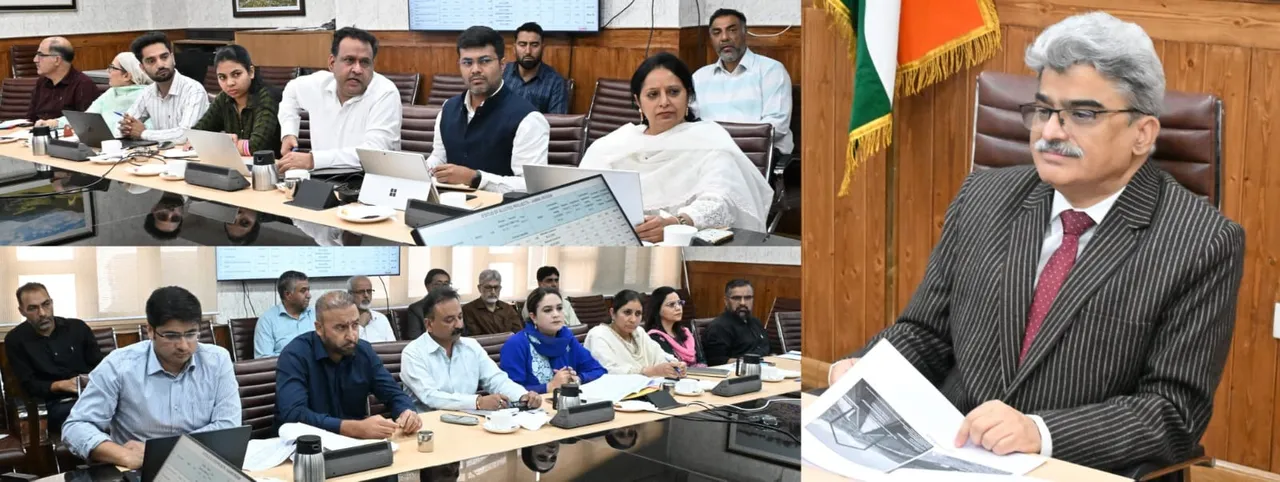
With Jammu and Kashmir making significant headway in modernising waste management and strengthening civic infrastructure under SBM-U and AMRUT 2.0, the Chief Secretary Atal Dulloo chaired a meeting to review the progress of these flagship Centrally Sponsored Schemes (CSS) aimed at transforming the Union Territory’s towns and cities into cleaner, greener and more sustainable urban centres.
The meeting was attended by the Commissioner Secretary, Housing & Urban Development Department; Commissioner, Jammu/Srinagar Municipal Corporations; Managing Director, J&K Housing Board; Director ULBs, Kashmir/Jammu; Chief Engineer, UEED; Chief Town Planner, Jammu/Kashmir; and other senior officers of the Department.
While speaking the Chief Secretary emphasised that the Swachh Bharat Mission must go beyond creating sanitation infrastructure to bring about a visible and lasting improvement in urban cleanliness, public health and the overall quality of life of citizens here.
He underscored that cleanliness is a basic necessity, assuming even greater significance in Jammu and Kashmir being a tourist area and given its ecologically sensitive environment and the imperative of preserving its fragile ecosystems.
He underscored that the success of SBM would ultimately be measured by cleaner neighbourhoods, efficient waste management and sustained behavioural change. He urged ULBs to actively engage communities and ensure that the infrastructure created under the mission delivers tangible benefits to the public.
The Commissioner Secretary, Housing & Urban Development Department (H&UDD), Mandeep Kaur took this occasion to present a comprehensive status of both the flagship urban development programmes, apprising the meeting of significant progress in scientific waste management, urban water security, wastewater treatment, legacy dumpsite remediation and technology-driven town planning.
She also highlighted the financial utilisation, timelines for ongoing works and measures being taken to achieve the targets within the stipulated schedules.
The Commissioner, JMC, Devansh Yadav, who is also the MD, SBM (Urban) & AMRUT, while talking over the presentation revealed that under SBM-U 2.0, against a total Phase-II allocation of ₹692.12 crore, expenditure of ₹96.97 crore has been recorded, with ₹57.95 crore available for ongoing works during the current financial year.
Elaborating further he apprised the meeting that the implementation of SBM-U 2.0 has achieved a significant progress here especially in dry waste processing, bio-remediation of legacy waste and establishment of waste-to-resource facilities.
It was revealed that out of the 78 Urban Local Bodies (ULBs) targeted for setting up Material Recovery Facilities (MRFs), 62 have completed the works, while the remaining 16 are targeted for completion by December 2026.
Additionally the meeting was informed that the 225 TPD Compressed Bio-Gas (CBG) plant of Jammu Municipal Corporation (JMC) has achieved 50 per cent physical progress. Meanwhile the 300 TPD CBG plant proposed by Srinagar Municipal Corporation (SMC) is presently under an extended bidding process.
In the Construction & Demolition (C&D) waste management sector, the 65 TPD JMC facility has been completed and is undergoing trials, while the 125 TPD SMC facility has achieved 95 per cent physical progress and set for completion by this year.
On legacy waste remediation, out of a total target of 26.29 lakh metric tonnes, 13.29 lakh MT has already been bio-remediated. JMC is scheduled to clear its remaining 0.80 lakh MT by October 2026, while complete remediation in the Kashmir Division is targeted by December 2026. Similarly work on the bio-remediation of 10.20 MT balance legacy waste of SMC is going on round the clock to be completed in a time-bound manner.
The meeting was also informed that treated wastewater from the Mehdi Kadal and Pahalgam STPs is being reused for irrigation of floriculture fields, promoting sustainable water-use practices.
With respect to AMRUT 2.0, the MD, divulged that a Central Assistance of ₹867 crore has been secured by the UT under this Mission, with works amounting to ₹852.90 crore already allotted. He further added that during the current financial year 2026-27, ₹113.51 crore has been utilised out of ₹150 crore released so far.
The meeting was informed that J&K has completed all 22 approved water-body rejuvenation works, marking a significant milestone in the restoration and revival of urban water resources.
Moreover of the 65 approved water supply schemes under AMRUT 2.0, seven have already been completed, while 30 are targeted for completion by December 2026 and another 18 are scheduled for completion by March 2027.
Under the ‘Jal Hi Amrit’ initiative, against an incentive of ₹10.50 crore sanctioned for 14 Sewage Treatment Plants (STPs), five works have been completed. The STPs had also been incorporated with advanced systems including SCADA and Online Continuous Effluent Monitoring Systems (OCEMS).
The meeting was further informed about the progress under the GIS-based Master Plan for Class-II towns, being implemented at a cost of ₹22.50 crore in collaboration with the Survey of India. Drone-based mapping has already been completed for 14 towns, while mapping of all 18 identified towns is scheduled for completion by October 2026.
It was also highlighted that the Community participation has also emerged as an important component of the urban transformation initiatives. In this direction Five Self-Help Groups (SHGs) had been engaged under the AMRUT Mitra initiative completing 100 per cent of the targeted 78,000 water-quality tests. Another 11 SHGs are undertaking green-cover initiatives and have so far planted 798 trees around sensitive water bodies and dumping sites.
Under sanitation workers’ welfare initiatives, H&UDD has profiled 7,422 Sanitation Response Workers (SSWs) and distributed 713 specialised PPE kits. As many as 627 workers have been covered under Ayushman Bharat Health Cards, while the National Sanitation Helpline 14420 is fully operational, the meeting was apprised.
The Chief Secretary also reviewed the department’s initiatives under the Clean Himalayan and Hill Cities Initiative (CHHCI), under which ₹22.37 crore is being deployed across key eco-tourism destinations.
At Katra, initiatives include container-based Pink Toilets and development of a plastic-free green corridor towards the Railway Station. In the same vein at Pahalgam and Patnitop, automated road sweepers, Reverse Vending Machines and women-friendly smart toilets are being introduced. Initiatives planned for Gulmarg/Tangmarg and Bhadarwah include a Waste-to-Wonder Park, eco-friendly SHG-based packaging and CCTV-enabled waste monitoring systems.
The Chief Secretary emphasised the need for sustained monitoring of ongoing works, adherence to prescribed timelines and effective utilisation of available resources to ensure that the benefits of these flagship urban development programmes reach citizens across the Union Territory.
