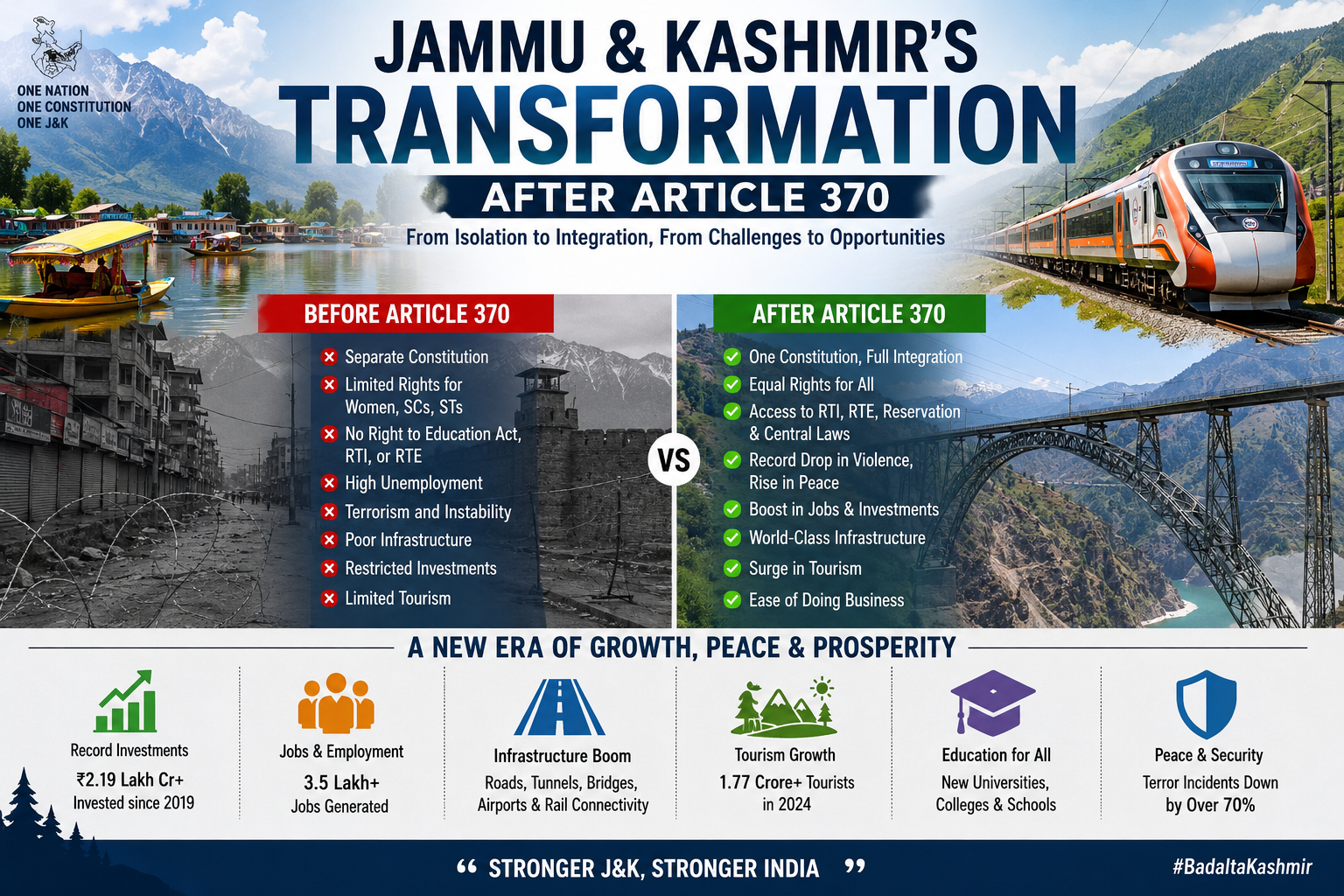
Kashmir is undergoing one of the most significant transformations in its modern history. Once known primarily for security challenges and prolonged instability, the region is increasingly being associated with development, improved infrastructure, tourism growth, investment, and expanding opportunities for its people. Over the past few years, a combination of enhanced security measures, infrastructure projects, governance reforms, and economic initiatives has contributed to a changing landscape across the Union Territory.
Compared with the previous decade, terror-related incidents have declined significantly, allowing normal life to resume in many areas. Markets remain open, schools function regularly, tourists continue to visit in record numbers, and businesses are operating with greater confidence. Residents across urban centres as well as remote districts are experiencing improvements in connectivity, public services, and economic opportunities.
A New Chapter Following the Abrogation of Article 370
A major turning point in Jammu & Kashmir’s recent history came with the abrogation of Article 370 in August 2019. The constitutional change marked the beginning of a new administrative and developmental framework for the region. Since then, government initiatives have focused on accelerating infrastructure development, improving public service delivery, strengthening institutions, encouraging private investment, and expanding welfare programmes.
The emphasis has been on ensuring that development reaches every district and every community. New roads, tunnels, bridges, healthcare facilities, educational institutions, and digital infrastructure have become central to the region’s development agenda.
While constitutional changes continue to be discussed from different political and legal perspectives, the developmental focus has remained a prominent aspect of the government’s policy approach toward Jammu & Kashmir.
Improved Security Brings Renewed Confidence
One of the most noticeable developments has been the improvement in the overall security environment. A decline in terror-related incidents compared with earlier years has contributed to greater confidence among residents, visitors, and investors.
The improved situation has enabled schools, colleges, businesses, transport services, and markets to operate with fewer disruptions. Public gatherings, festivals, sporting events, and cultural programmes have become increasingly common across different parts of the Union Territory.
For many families, the changes represent an opportunity to focus on education, employment, entrepreneurship, and community development instead of living under constant uncertainty.
Development Reaches Every Corner
Infrastructure development has become one of the defining features of Jammu & Kashmir’s transformation. Large-scale public investments have significantly improved road connectivity between districts while reducing travel time through the construction of modern highways and tunnels.
Projects including expanded national highways, upgraded rural roads, new bridges, railway expansion, and strategic tunnels have improved access to remote regions that historically faced connectivity challenges, particularly during winter months.
Modern transport infrastructure is helping improve logistics, reduce transportation costs, promote tourism, and facilitate economic activity throughout the region.
Digital connectivity has also expanded rapidly. Improved internet infrastructure and digital public services have enhanced access to education, banking, government schemes, healthcare, and e-governance platforms.
Tourism Records Historic Growth
The tourism sector has emerged as one of the strongest indicators of Jammu & Kashmir’s changing image. The region has witnessed record tourist arrivals in recent years, reflecting growing confidence among travellers.
Popular destinations including Srinagar, Gulmarg, Pahalgam, Sonamarg, Doodhpathri, Yusmarg, Jammu, Patnitop, Bhaderwah, and other scenic locations continue to attract visitors from across India and abroad.
Tourists are drawn by Kashmir’s breathtaking landscapes, Mughal gardens, Dal Lake, snow-covered mountains, adventure sports, religious tourism, traditional handicrafts, and unique cultural heritage.
The revival of tourism has generated substantial employment across multiple sectors including hotels, restaurants, transport services, tour operations, handicrafts, local markets, photography, adventure tourism, and food businesses.
Thousands of families who depend directly or indirectly on tourism have benefited from increased visitor numbers and longer tourist seasons.
Economic Growth and Investment
Improved infrastructure and enhanced connectivity have strengthened the overall business environment in Jammu & Kashmir.
Government initiatives promoting industrial development, entrepreneurship, agriculture, horticulture, handicrafts, food processing, information technology, and manufacturing are creating new opportunities for investment.
Traditional industries including carpet weaving, shawl production, papier-mâché, wood carving, saffron cultivation, apple farming, walnut production, and dry fruit processing continue to play an important role in the regional economy while also expanding access to national and international markets.
Small businesses, start-ups, women entrepreneurs, and self-help groups are increasingly participating in economic activities supported through financial inclusion programmes, skill development initiatives, and digital commerce.
Better Education for Future Generations
Education has remained an important area of development. Investments in schools, colleges, higher education institutions, digital classrooms, vocational education, and skill development programmes aim to prepare young people for emerging employment opportunities.
Students now have improved access to online education, scholarship programmes, career guidance, and professional training. Educational infrastructure has expanded in several districts while greater digital connectivity enables students to access national learning platforms and competitive examination resources.
Skill development programmes focusing on technology, hospitality, tourism, healthcare, entrepreneurship, agriculture, and manufacturing are helping young people build careers across multiple sectors.
Healthcare Infrastructure Expands
Healthcare services have also witnessed significant expansion through investments in hospitals, medical colleges, primary health centres, diagnostic facilities, emergency services, and telemedicine.
Improved healthcare infrastructure allows residents to access specialised medical treatment closer to home while reducing dependence on facilities outside the region.
Digital healthcare initiatives and expanded medical education are contributing to a stronger public health ecosystem.
Employment and Entrepreneurship
Employment generation remains a key priority for Jammu & Kashmir’s development.
Government recruitment drives, infrastructure projects, tourism growth, industrial investment, agriculture, horticulture, and expanding service sectors have created new employment opportunities.
Entrepreneurship has gained momentum through support for start-ups, innovation centres, financial assistance programmes, and skill-based enterprises.
Young entrepreneurs are increasingly launching businesses in technology, tourism, e-commerce, handicrafts, food processing, agriculture, digital services, and creative industries.
Women-led enterprises and self-help groups are also contributing to local economic development through handicrafts, food production, textiles, and community-based businesses.
Agriculture and Horticulture Continue to Grow
Agriculture remains a vital pillar of Jammu & Kashmir’s economy.
The region continues to strengthen its position in apple production while also promoting cherries, walnuts, almonds, saffron, honey, flowers, medicinal plants, and high-value horticultural products.
Modern farming techniques, improved irrigation, cold storage infrastructure, better logistics, and expanded market access are helping farmers increase productivity and income.
Food processing industries are also creating additional value for agricultural produce while generating rural employment.
Improved Connectivity Strengthens Regional Integration
Connectivity projects have significantly improved access across Jammu & Kashmir.
Major highways, railway expansion, upgraded airports, bridges, tunnels, and rural road networks are connecting previously isolated communities with markets, healthcare facilities, educational institutions, and tourism destinations.
Improved transportation supports trade, emergency services, tourism, investment, and overall economic development while reducing travel time throughout the region.
Cultural Heritage Receives Renewed Attention
Alongside physical infrastructure, efforts continue to promote Jammu & Kashmir’s rich cultural heritage.
Traditional crafts, regional festivals, music, cuisine, architecture, and local art forms remain central to the region’s identity.
Heritage conservation projects, tourism promotion, and support for artisans are helping preserve cultural traditions while creating new economic opportunities.
Growing National and International Recognition
Jammu & Kashmir is increasingly being recognised for hosting international events, sporting competitions, cultural festivals, tourism conferences, investment summits, and public programmes.
Improved infrastructure and enhanced connectivity have enabled the region to host larger events while attracting greater national and international attention.
The positive visibility generated through tourism and investment has contributed to changing perceptions about the region.
Looking Towards the Future
The transformation of Jammu & Kashmir reflects an ongoing process of development, infrastructure expansion, economic diversification, and institutional strengthening. Reduced terrorism, improved connectivity, record tourism, expanding healthcare, better education, entrepreneurship, and increased investment have collectively contributed to greater confidence among many residents.
Challenges remain, as they do in any developing region, and continued progress will depend on sustained investment, inclusive governance, economic opportunity, and long-term peace. Nevertheless, the current trajectory highlights a region that is increasingly focused on growth, innovation, and prosperity.
Today, Jammu & Kashmir stands at an important moment in its journey. From peaceful streets and thriving tourism to expanding infrastructure and new employment opportunities, the Union Territory is steadily building a future centred on development, resilience, and opportunity. As roads connect distant villages, students access better education, businesses expand, and visitors continue to discover the region’s natural beauty, Jammu & Kashmir continues to move forward with renewed confidence and optimism.
