
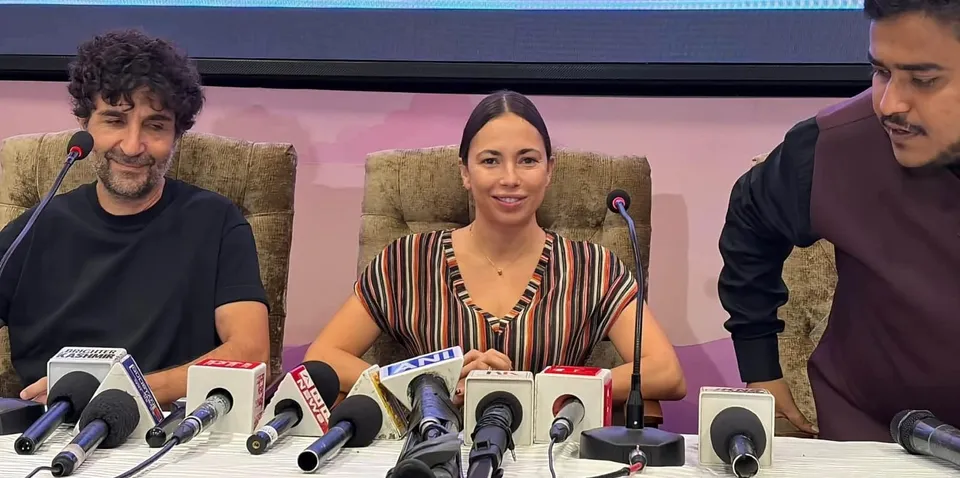
Renowned Spanish film producer Anna Saura Ramón on Wednesday called for stronger institutional and industry-level ties between India and Spain to facilitate film co-productions, distribution and exchange of cinema.She said both countries have significant opportunities to learn from each other.
Talking to reporters on the sidelines of the First International Film Festival of Jammu & Kashmir (IFFJK), Ramón said film festivals play a crucial role in promoting independent cinema and creating opportunities for filmmakers and audiences to discover films that may otherwise remain inaccessible.
“I think film festivals are very important for the entire cinema industry, not only the Indian industry,” she said.
She added that smaller festivals are equally significant as they provide a platform for non-commercial and independent films.
Ramón, who was visiting Kashmir for the first time, said she was impressed by the festival and the region’s landscape, describing Kashmir as a place with considerable potential for cinematic storytelling.
She said her brief visit had already allowed her to experience the beauty of Dal Lake, local markets and traditional culture.The sunset was amazing yesterday,” she said.
She also congratulated the organisers for successfully holding the first edition of the festival. She expressed hope of returning next year and said it was not easy to make a film festival. “It is not easy to make the first edition of a film festival. So, hope to come back next year. Long life to the festival,” she added.
Ramón stressed the need to strengthen connections between Indian and Spanish distributors, international sales companies and theatre chains to increase the circulation of films between the two countries. She said language should not be a major barrier as films could be subtitled or dubbed, but stronger commercial and institutional mechanisms were needed to ensure Indian films reach Spanish audiences and Spanish films find wider distribution in India.
“There has to be more relationships between Spain and India, to get the distributors and also the international sales companies to get the film from India, to sell it in Spain, and the same, the Spanish films to get it in India,” she said.
She added that 2026 is being observed as a year of enhanced Spanish-Indian engagement, with several initiatives being undertaken to strengthen cultural ties. Ramón said the effort should involve both governments and the film industry, including possible arrangements with theatres to facilitate the screening of films from the two countries.
Asked about the potential of Kashmir as a filmmaking destination, Ramón said she needed more time to understand the region and its social and cultural landscape but acknowledged its strong visual appeal.
She said people in Spain were already fascinated by images of India and Kashmir, particularly its mountains and landscapes.“I think that is the thing that you have to promote, that there is a very nice place with a really nice landscape where we can find the stories to make a movie,” she said.
Ramón said that any future film shot in India would involve Indian actors and crew members. Ramón said she had already worked on a Spanish co-production in India with producer Bobby Bedi, where almost the entire crew was Indian.
“If we shoot a movie here in Kashmir, or even in any part of India, we should cast people from India, and we should hire Indian crew, of course,” she said.
From a producer’s perspective, Ramón described India as an important partner for international filmmaking, particularly in areas such as visual effects and animation. She said Spanish filmmakers had already worked with Indian VFX companies, saying there was considerable scope to expand such collaboration. “India has been for us, for example, in VFX services, a big partner, because we have worked a lot with VFX companies here in India,” she said.
She added that the challenge was to identify mechanisms through which the two industries could collaborate not only on technical services but also on fiction films and other creative projects.
On the growing use of artificial intelligence in filmmaking, Ramón described AI as a “very big tool” that would become increasingly important in the industry.
