
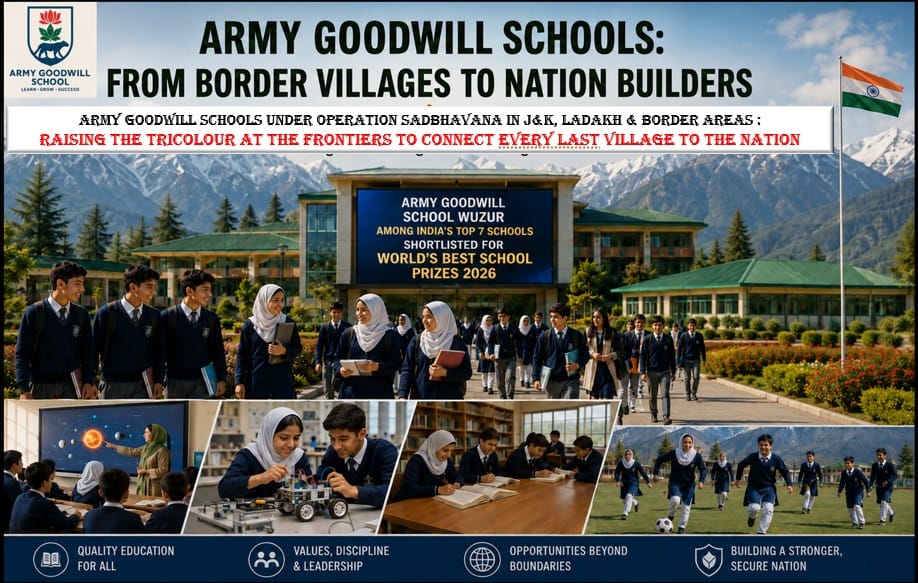
At the far edges of India, where rugged mountains meet the sky and the landscape tests human endurance, the Indian Tricolour acquires a special significance. In these remote frontiers of Ladakh and Jammu & Kashmir, classrooms run by the Indian Army have become quiet yet powerful centres of nation-building. Army Goodwill Schools do far more than impart formal education. They nurture patriotism, discipline, and a deep sense of belonging among children who grow up in some of the country’s most challenging environments.
These schools operate in places where ordinary educational infrastructure has historically struggled to reach. In high-altitude regions, snowbound valleys, and areas once marked by isolation or conflict, the Army stepped in to fill a critical gap. The result is a network of institutions that provide free education, hostels, coaching support and innovative outreach methods such as “Courier Schools” that deliver learning materials to children cut off by harsh winters. For a child from Drass, Kupwara, or a remote Gujjar hamlet, these schools represent more than books and blackboards. They signal that the nation sees them, values them and invests in their future. Education here extends well beyond textbooks.
Students participate in National Cadet Corps drills that instil physical fitness, teamwork, and respect for hierarchy. Sports programmes build resilience and healthy competition. Value education classes emphasise integrity, civic responsibility and ethical conduct. Through these activities, young minds learn that personal excellence and national service are closely linked. Discipline is not enforced as mere obedience; it is presented as a foundation for character and contribution. National days acquire special meaning in these border classrooms. On Independence Day, Republic Day, and Kargil Vijay Diwas, children stand in formation for flag hoisting. They sing the national anthem with genuine emotion and listen to accounts of soldiers who defended the same mountains and valleys they call home. These ceremonies are not abstract rituals.
They connect personal identity with the larger story of the nation. When a student hears of the sacrifices made at Kargil or along the Line of Control, the lessons of history become immediate and local. The Tricolour ceases to be a distant symbol and becomes a living presence in daily life. Soldiers themselves play a central role in this transformation. Beyond their primary duties of security, they serve as teachers, mentors, and role models. In classrooms and hostels, uniformed personnel interact with students regularly. They demonstrate that service to the nation can begin in the most ordinary settings—attending school, completing homework, helping a classmate, or respecting the flag. For many children, these interactions provide the first consistent examples of structured guidance and national commitment.
The presence of the Army conveys both protection and aspiration: the same institution that guards the borders also invests in the minds of the next generation. Inclusivity forms another cornerstone of the Army Goodwill School model. Students from diverse communities-Gujjar, Bakarwal, Balti, Purgi, and others—study side by side. In regions where social differences could easily create distance, the shared classroom experience fosters unity. Children learn to appreciate common citizenship over narrower identities. This everyday practice of unity in diversity builds trust where it is most needed. It softens historical fault lines and replaces suspicion with shared purpose.
Graduates leave not only with literacy and skills but with a lived understanding that India’s strength lies in its ability to hold many identities within one national framework. The practical impact of these schools is visible in improved literacy, rising confidence, and stronger career aspirations among students. Free education removes financial barriers. Hostels provide stable environments for children from dispersed settlements. Coaching programmes prepare older students for competitive examinations and higher studies. Courier Schools ensure that even temporary isolation due to snowfall does not interrupt learning. Collectively, these measures produce young citizens who are literate, disciplined, and oriented toward national progress rather than narrow self-interest. Every graduate of an Army Goodwill School becomes a potential pillar of a stronger, more integrated, and self-reliant India. Some may join the armed forces or civil services. Others will contribute as teachers, entrepreneurs, or community leaders. What unites them is an early education that links personal advancement with collective responsibility.
In an era when national cohesion faces multiple pressures, these border institutions quietly reinforce the foundations of citizenship. From the valleys of Kashmir to the high plateaus of Ladakh, Army Goodwill Schools ensure that the Tricolour does not fly only on flagpoles. It takes root in the minds and hearts of children who will shape the country’s future. By combining quality education with disciplined values and patriotic orientation, these schools transform remote classrooms into laboratories of nation-building. They demonstrate that the defence of a country is not limited to borders and weapons. It also depends on the character, knowledge, and commitment of the generation that grows up at the frontiers. In this quiet work of teaching and mentoring, the Indian Army continues to serve the nation in one of its most enduring forms.
