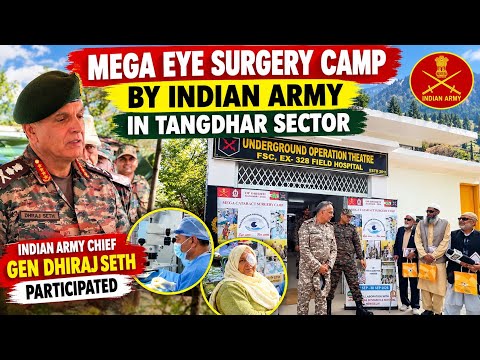
Over two days in late September 2026, military surgeons worked inside an underground operating theatre in Tangdhar, a sector of Kupwara that sits uncomfortably close to the Line of Control and has a long history of shelling. By the time they finished, 220 people had undergone eye surgery — the bulk of them cataract removals, alongside a handful of retinal and glaucoma procedures. Patients arrived from small settlements scattered around the sector, drawn in after local screening drives and radio announcements. Army Chief General Dhiraj Seth and the head of the Armed Forces Medical Services, Air Marshal Sandeep Thareja, both visited the camp in person.
This was the tenth large-scale medical camp under Operation Drishti, and the first ever conducted right at the LoC. It belongs to a wider initiative pushed by Defence Minister Rajnath Singh that has now screened well over 150,000 people and carried out more than 3,500 surgeries at ten different sites. A follow-up camp is scheduled for Srinagar at the end of September.
What makes this notable isn’t just the count of surgeries — it’s where they happened. Tangdhar has taken heavy fire during past periods of tension, and a military hospital in the area has itself come under attack before. Hauling delicate eye-surgery equipment through mountain terrain and operating beneath ground level isn’t a photo opportunity; it signals that advanced medical care will follow people even into the most exposed corners of the border.This effort sits within a much older program — Operation Sadbhavana, the Army’s decades-long attempt to build goodwill through healthcare, education and sport in the very areas where it also conducts counter-infiltration operations. The reasoning is practical as much as humanitarian: for many border families, a trip to Srinagar for eye surgery is simply unaffordable once travel and lodging are factored in. Free treatment delivered locally removes that obstacle entirely, and for elderly patients in particular, it can mean the difference between dependence and independence.
Education follows the same pattern. Northern Command now operates over 40 Army Goodwill Schools across Jammu and Kashmir and Ladakh, serving roughly 15,000 to 16,000 students, many from remote or conflict-affected areas. Recent reporting has noted improved attendance following digital classroom investments, a growing number of students qualifying for NEET, and alumni going on to institutions like the IITs and NITs — evidence that these schools function as a genuine alternative in regions where private schooling is scarce.
Sport plays a similar role. Army-organized volleyball leagues, archery and shooting programs for girls, cultural festivals, and exchange trips to cities like Delhi and Amritsar all serve a purpose beyond recreation. In a region where drug abuse — much of it tied to narcotics trafficking linked to Pakistan-based militant financing — has become a serious problem among young people, structured sport offers a rival pull. A teenager training for a weekend match is one less potential target for a drug courier or recruiter.
That’s the underlying logic connecting all three efforts. Militant and criminal networks based across the border have long used both violence and narcotics to destabilize the region and recruit vulnerable youth. The Army’s combat operations address the security threat directly; its civic programs try to shrink the social conditions that make recruitment and drug abuse possible in the first place.
None of this erases the region’s underlying tensions — shelling risks remain, drug seizures continue, and militant networks still get disrupted regularly. But camps like the one at Tangdhar show a military presence that isn’t defined solely by weapons and checkpoints. It’s also defined by restored eyesight, functioning classrooms, and a volleyball court — visible, tangible reasons for communities to see the Army as something more than a force holding a line.
