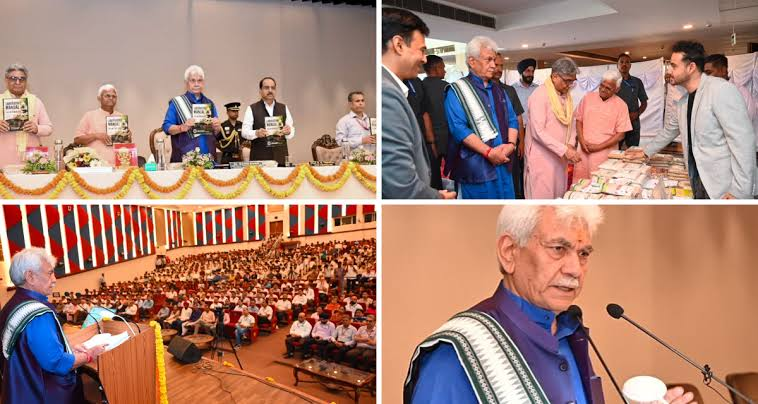
In a significant step toward building a healthier and more sustainable food ecosystem, Lieutenant Governor Manoj Sinha today inaugurated the National Seminar on the Millets Mission in Jammu and Kashmir. The event brought together policymakers, agricultural scientists, farmers, entrepreneurs, and nutrition experts to deliberate on how millets—once dismissed as “coarse grains”—can be repositioned at the heart of India’s food security and public health strategy.
Speaking on the occasion, the Lieutenant Governor said the seminar draws its inspiration from Prime Minister Narendra Modi’s vision of “Shree Anna,” a term that elevates millets from ordinary crops to symbols of national pride and resilience. Under this vision, India has been working to revive its ancient grain heritage, recognizing that foods once considered staples of rural households hold the key to addressing some of the most pressing challenges of our time: climate change, malnutrition, and the economic vulnerability of small farmers.
Why Millets, Why Now
Millets are uniquely suited to India’s diverse agro-climatic conditions. They require minimal water, thrive in arid and semi-arid regions, and can withstand extreme weather patterns—qualities that make them a natural ally in the fight against climate change. As erratic rainfall and rising temperatures increasingly threaten conventional crops, millets offer a resilient alternative that can secure yields even in adverse conditions.
Nutritionally, millets are powerhouses. Rich in fiber, protein, essential minerals, and antioxidants, they help combat lifestyle diseases such as diabetes and obesity while addressing malnutrition in vulnerable populations. Their reintroduction into everyday diets is not merely a culinary shift but a public health intervention with far-reaching consequences.
Empowering Farmers and Women Entrepreneurs
Central to the Millets Mission is the empowerment of small and marginal farmers, who form the backbone of J&K’s agricultural economy. The Lieutenant Governor emphasized that promoting millet cultivation would reduce input costs for farmers—since millets require fewer fertilizers and pesticides compared to water-intensive crops—while opening new market opportunities through value addition and processing.
Women entrepreneurs are emerging as key stakeholders in this transformation. Across Jammu and Kashmir, self-help groups and women-led enterprises are being trained in millet processing, packaging, and marketing, turning traditional knowledge into viable livelihoods. This dual focus on climate resilience and economic empowerment reflects the administration’s broader approach to rural development, one that treats sustainability and prosperity as complementary goals rather than competing priorities.
Restoring a Forgotten Heritage
For generations, millets such as ragi, jowar, bajra, and kodo were dietary staples across India, valued for their taste, nutrition, and ease of cultivation. The Green Revolution’s focus on rice and wheat gradually pushed millets to the margins of both farms and plates. Today’s seminar represents a conscious effort by the J&K administration to reverse that trend, restoring millets to their rightful place in the region’s culinary and agricultural identity.
This revival is not about nostalgia alone; it is about building a food system that is resilient, inclusive, and rooted in indigenous wisdom. By integrating traditional crops with modern science and market linkages, the Millets Mission bridges the gap between heritage and innovation.
A Shared Responsibility
As the Lieutenant Governor underscored during the seminar, millets are far more than agricultural commodities—they are instruments of health, sustainability, and self-reliance. He called for collective action: government bodies, research institutions, farmers, and consumers must work together to mainstream millets into everyday life in Jammu and Kashmir.
The vision he articulated was clear and compelling: a future where every plate carries genuine nourishment, and every village carries renewed hope. As the Union Territory continues its journey toward greater self-reliance, the humble millet stands poised to play an outsized role—not just as a grain, but as a symbol of a healthier, more sustainable, and more equitable tomorrow for Jammu and Kashmir.
