
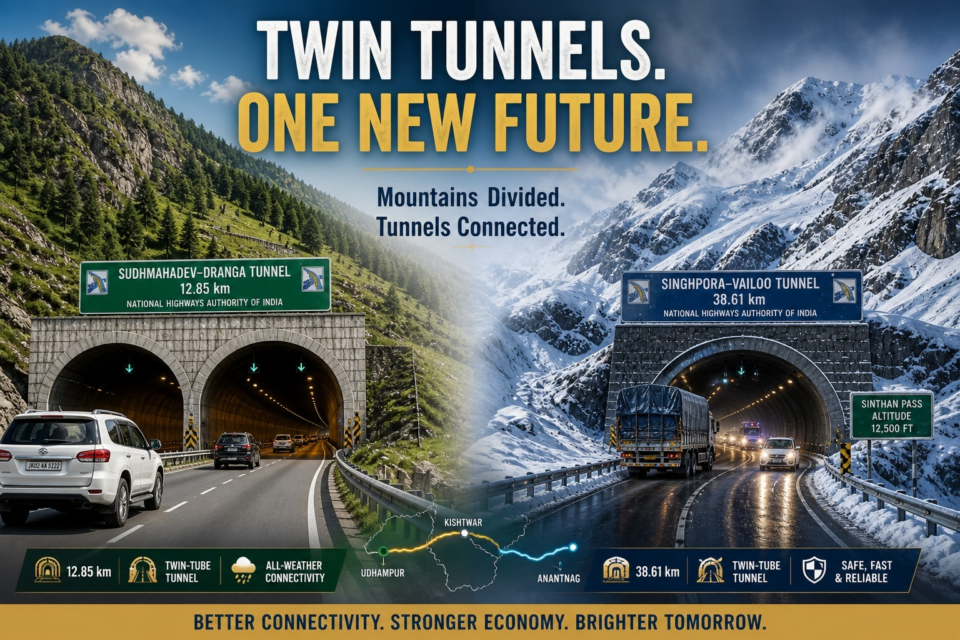
The mountains of Jammu & Kashmir have long shaped the region’s identity, beauty, and challenges. For decades, harsh winters, landslides, snowfall, and difficult terrain often cut off communities, slowed economic activity, and made travel risky and unpredictable. Today, that reality is steadily changing through the construction of modern twin-tube tunnels across the Union Territory — engineering projects that are transforming mobility, connectivity, and everyday life.
These tunnels are not merely infrastructure projects; they are symbols of a new era where geography is no longer allowed to dictate opportunity. By cutting through mountains that once acted as barriers, Jammu & Kashmir’s twin-tube tunnels are becoming bridges of development, ensuring safer, faster, and all-weather connectivity for millions.
Redefining Connectivity in the Himalayas
Road travel in Jammu & Kashmir has historically been vulnerable to weather disruptions. Snowfall and avalanches frequently blocked highways, isolating districts and delaying the movement of people, essential supplies, trade, tourism, and emergency services. The new generation of twin-tube tunnels is addressing these longstanding challenges directly.
Unlike traditional single-tube systems, twin-tube tunnels separate traffic movement into dedicated passageways, significantly improving safety, reducing congestion, and enabling smoother transportation. Advanced ventilation systems, emergency exits, fire safety mechanisms, surveillance, and weather-resistant design are making travel more secure than ever before.
The tunnels are helping reduce travel time drastically, allowing commuters, transporters, students, tourists, and patients to move more efficiently even during harsh weather conditions. Regions that once remained cut off for days are now being connected year-round.
Ending Seasonal Isolation
For many remote areas of Jammu & Kashmir, winter isolation was once considered inevitable. Families struggled with supply shortages, businesses suffered losses, and emergency response became difficult during prolonged road closures.
The twin-tube tunnel projects are changing this reality. All-weather connectivity ensures that villages and towns remain accessible throughout the year, strengthening social and economic integration. Farmers can transport produce faster, traders can maintain uninterrupted business activity, and students and workers can travel with greater certainty.
This connectivity is also improving access to healthcare and education. Ambulances and emergency services can now move more reliably through difficult terrain, while students from remote regions benefit from safer daily travel.
Boosting Tourism and Economic Growth
Tourism remains one of Jammu & Kashmir’s most important economic drivers, and improved road infrastructure is playing a critical role in strengthening the sector. Faster and safer travel encourages more visitors to explore the region across all seasons.
Reduced travel time and improved highway reliability are helping local businesses, hotels, transport services, handicraft sectors, and tourism operators. Better logistics also support trade and industrial movement, opening new opportunities for investment and employment.
Infrastructure development creates a multiplier effect. Every tunnel not only improves mobility but also generates jobs, stimulates markets, and increases economic confidence in surrounding areas.
Engineering Development into Reality
The scale and complexity of these tunnel projects demonstrate a major leap in infrastructure capability. Constructing tunnels through the fragile Himalayan terrain requires advanced engineering, precision planning, and continuous monitoring.
Yet these projects represent more than technical achievement. They reflect a larger vision of inclusive development where modern infrastructure reaches even the most challenging geographies. Roads that once symbolized difficulty are now becoming corridors of growth and national integration.
The transformation is visible not only in reduced travel hours but in the confidence of communities who now see consistent connectivity as a reality rather than a distant promise.
Development That People Can Experience
Infrastructure is most meaningful when people can experience its impact in daily life. Jammu & Kashmir’s twin-tube tunnels are making development visible and drivable. They are improving safety, strengthening resilience, and creating opportunities that were once limited by geography.
By turning mountains into pathways of connectivity, these projects are helping Jammu & Kashmir move toward a future defined not by isolation, but by accessibility, growth, and progress. The tunnels stand today as powerful examples of how infrastructure can unite regions, empower communities, and reshape the future of an entire landscape.
Key Highlights of the Project Project: 4-Lane Digdol–Panthyal Twin Tube Tunnels in Ramban-Banihal section of NH-44
Location: Jammu & Kashmir
Tunnel Length: North Bound: 2.6 km & 0.619 km
South Bound: 3.08 km
Project Cost: ₹866.37 Crore
