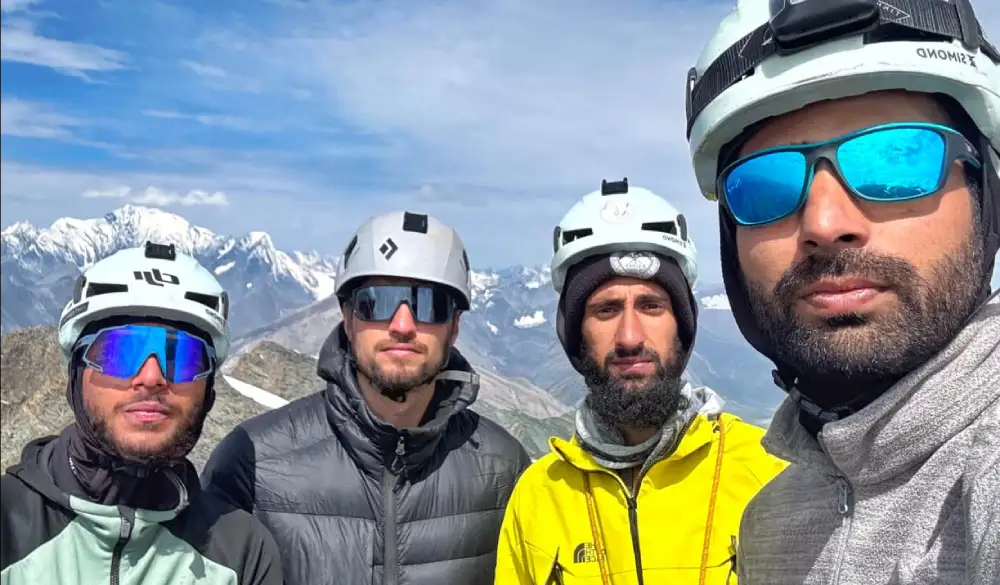
Four climbers from Srinagar have opened a new route on Koh e Noor South-West, the highest peak of the Kohenoor massif in Kishtwar’s Marwah valley, climbing the mountain from a side that had not been attempted by any recorded expedition before. The ascent marks the first recorded summit of the peak in nearly fifty years.The team of Muzakir Khan, Yasir Khan, Faik Aijaz Pattoo and Saqib Shafi, all aged between 20 and 30, reached the 5,146-metre summit at 1:15 pm on September 6 after nearly nine hours of climbing from their base camp. Earlier records list the peak’s elevation at 5,136 metres.The peak was last climbed in August 1976 by a Japanese expedition.
The expedition began on September 4, when the team travelled from Srinagar to Sukhnai village in Marwah at around 2,800 metres. They had planned to proceed to Koh e Noor Lake the same day but stayed overnight in the village.They resumed the approach at 5 am the following morning, intending to bypass a conventional base camp and establish an advanced camp directly on the Sheeshnag glacier, above the col separating Kohenoor South-West from Koh e Noor Central.
The trail rose steeply from the valley floor and the team reached Koh e Noor Lake, located at around 4,060 metres, by 10:30 am.
By 1:30 pm, however, weather conditions deteriorated near the glacier’s snout. Hail turned into snow before a complete whiteout forced the climbers to halt their advance.
The team took shelter under a rock, covering themselves and their equipment with a tarp while waiting for the weather to improve. When conditions failed to ease, they abandoned plans for the advanced camp and descended around 400 metres to a shepherd’s hut, or doka, roughly 200 metres below the lake.
They reached the doka at around 4 pm. Located at approximately 3,860 metres, it became their base camp.
The change in plans also forced a change in climbing strategy. Instead of carrying heavy loads to an advanced camp, the team decided to make a direct summit attempt from the base camp, keeping their equipment to a minimum.
They left the base camp at 4:30 am on September 6 and regained the previous day’s lost elevation within two hours.
Moving across the glacier, they reached the 4,750-metre col between Kohenoor South-West and Koh e Noor Central at around 8:10 am. The climbers then roped up, fitted crampons and crossed the Sheeshnag glacier, negotiating crevasses and the bergschrund before reaching the north-eastern face of Kohenoor South-West.
Beyond that point, the route was previously unexplored in their records. The team had plotted a possible line on the map before the expedition and followed it during the ascent.
A steep wall took nearly two hours to gain around 200 metres of elevation. The summit arête above presented another challenge, with a narrow and exposed ridge broken by several pinnacles that the climbers had to traverse individually.
They reached the summit at 1:15 pm.
From the top, the climbers had views of Thajiwas, Kolahoi, Amarnath, Nanga Parbat, Nichheng, Katsal, Kallatip, Brammah, Flat Top, Sickle Moon, Nun Kun, the Zanskar range and peaks overlooking Warwan and Kishtwar.
The team left a rock piton on the summit as a marker.
The descent presented a different challenge. Considering the north-eastern face unsuitable for descent, the climbers chose the south-western side, negotiating steep gullies and traversing ridgelines in an area prone to heavy rockfall.
Rocks continued to fall around them during the afternoon. The team reached its base camp at around 7 pm and walked back to Sukhnai the following morning.
The new route has been named the One Day Boys- Up and Down route.
The climb was completed in alpine style. Porters carried equipment only up to the base camp, while the climbers used no fixed ropes, supplementary oxygen or high-altitude camps beyond it.
A Century of Climbing on Koh e Noor
The Koh e Noor massif comprises three principal summits: Kohenoor South-West, the highest at a recorded 5,136 metres; Koh e Noor Central, also known as Kunyirhayan, at 5,036 metres; and Kohenoor North-East at 4,966 metres.
The massif has a climbing history dating back more than a century.
In September 1898, British mountaineer CG Bruce climbed the north-eastern summit, while Karbir, the Gorkha climber accompanying him, reached the south-western and highest summit.
The central peak was climbed in 1911 by Captain JB Corry, Lieutenant RD Squires, members of the Sherwood Foresters and Dr Ernest Neve.
In 1972, an American-Kashmir expedition led by Mohammad Ashraf, then Director General of Tourism, climbed all three summits. The team included Nazir Ahmad, Vijay Kumar and Mohammad Aslam alongside American climbers.
A Japanese expedition repeated the ascent of all three peaks in August 1976.
No subsequent summit ascent of the massif has been recorded since then, according to the climbers.
While mountaineers continued to approach the massif from the Sheeshnag side in later years, the team said none of those attempts reached a summit.
The September ascent also differed in its approach. Recorded expeditions to the Kohenoor peaks, whether successful or unsuccessful, had approached from Sheeshnag and proceeded towards the glacier.
The four Srinagar climbers instead approached from Sukhnai in the Marwah valley, reaching the col between Koh e Noor Central and Koh e Noor South-West from the opposite side before continuing towards the summit.
According to the team, no recorded expedition had previously climbed this line to the top.
The ascent forms part of the team’s wider effort to open and document new climbing routes in Kashmir.
“We are opening new routes in Kashmir so that fellow climbers can come and climb them, and so we can revive and promote alpinism and mountaineering in the valley,” the climbers said.
